Sunday, February 15, 2015

Emob 6 in 1 Educational Solar Energy Kit Brain Storming Games


Emob 6 in 1 Educational Solar Energy Kit Brain Storming Games (Blue, White) 

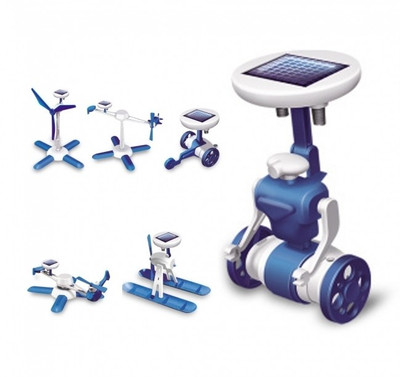
This is a solar educational kit by which you can show and teach children the important benefits of solar energy.  This is a good step for the children to start learning about solar energy.  This is something like fun and easy to inspire the interest in children.  From this kit, you can create six different fun solar toys to play and show how the solar power is used to drive small electric motor.  It is very easy to assemble and no tools are required for the 6 in 1 robot kit.  You can make models like car, robot, wind mill, helicopter and air boat.  This could be a learning and play tool for children as well as parents.

Features of the Emob 6 in 1 educational solar energy kit

  • Suitable for age groups :  8  to 15 years
  • Type of product :  Science and Discovery
  • Character : Windmill, Robot, Helicopter, Plane, Air boat and Wheeler
  • Powered by  : Solar power .   no battery required


How to buy this product

This product is available from FlipKart website for a price of Rs. 327.  The actual price is Rs.990 where as Flipkart is providing a discount of 66% and is available at Rs.327. The procedure to buy this product from Flipkart website is given below.


  • Just visit www.flipkart.com
  • After visiting the above link,  click on "Buy Now" button
  • Follow the instructions given there after clicking on "Buy Now" and make the payment 
  • Once the product is purchased, it  will be delivered within 3 to 4 days to your postal address by Flipkart.


EViO ESP-3000-PM1085-BL EViO 3000 mAh Solar, USB Power Bank 3000 mAh

Do you want to charge your mobile in a remote place where there is no power supply available?   Is it possible to charge the mobile phone at a place where there is no electricity and the mobile battery down?  Yes!  it is now possible with the EviO ESP-1200-1028MS-BL battery bank.   

The EViO ESP-3000-1PM1085-BL  is a  3000 mAh dual solar and USB power bank which is an excellent battery back up for the mobile devices and smart phones.  The mobiles can be charged through direct sun light or USB.  The device uses the latest technology in solar panels to provide efficient charging solution.   The device is very light weight but durable and compact size and designed for outdoor use.  So you can charge your mobile phone at any place even in the forest,  only thing is that there should be sun light.  Here are general specifications of the solar battery bank from EviO.


Specifications :


  • Connectors :  Mini USB, Micro USB, iPhone
  • Brand : EViO
  • Designed for :  MP3/MP4 Players, GPS, Mobile Phones, Suitable to Power up and Charge iPod, PDA, Bluetooth and Other Digital Devices, Digital Cameras, PSP
  • Model Number : ESP-3000-1PM1085-BL
  • Battery capacity : 3000 mAh
  • Battery type : Li-Polymer battery
  • Power source : USB  or Solar
  • Color : Black


How to buy this product

The product is available with 1 year warranty from Flipkart website.  The package contains Blackberry connector, Nokia small PIn, iPhone PIn, Mini USB, 1 piece of charging and discharging cable, Samsung Pin, 1 piece of manual and warranty card.  The product is available for a price of Rs. 1,599 from Flipkart website. The actual price is Rs.2,499 but the website is offering a discount of 36%.   Here is the procedure to buy the product from Flikpkart website.

  • Visit www.FlipKart.com website first.
  • After visiting the above link,  click on "Buy Now" button
  • Follow the instructions given there after clicking on "Buy Now" and make the payment
  • Once the product is purchased, it  will be delivered within 5 to 6 days to your postal address by Flipkart.


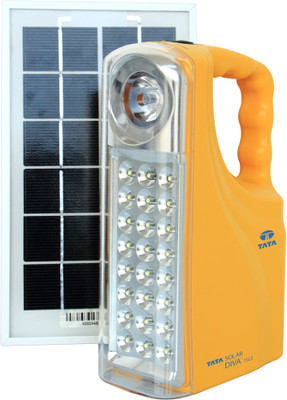
TATA Power Solar Diva 15L2 Solar Lantern

The TATA Power Solar Diva 15L2 Solar Lantern is a product from TATA Solar Power.  This device can serve as a torch or as a table lamp.  The device has adjustable brightness
settings for the torch.  Over-charge, over-discharge and short circuit protection are provided. There is also an indication for battery's state of charge.  Some of the features of this produce are listed.


Components of the system :  

    • Solar module / array: 3Wp
    • High efficiency LED luminaire: 2W (Torch light) + 1.2W (Table lamp)
    • Sealed maintenance free Li-ion battery: 3.7V-3Ah 
    • 2-in-1 mobile phone charging cable
    • USB charging cable for charging through AC

Features available :

    • Mobile phone charging option available
    • Compatible with both AC charging and solar module
    • Up to 6 and 4 hours of continuous operation from a single charge for Table light and Torch respectively
    • Charging time: 5 hours

How to buy this product:

This produce is available from Flipkart website.  It is available for a price of Rs.1900.  Here is the procedure to buy this product from FlipKart website.  .

  • Just visit www.flipkart.com
  • After visiting the above link,  click on "Buy Now" button
  • Follow the instructions given there after clicking on "Buy Now" and make the payment 
  • Once the product is purchased, it  will be delivered within 3 to 4 days to your postal address by Flipkart.


Benefits of Solar Power

Solar Panels also called as Photovoltaic or PV modules convert sunlight directly  into electricity.  The solar panels reduce the amount of electricity coming from fossil fuels by supplying the electricity with clean, renewable energy from sun.

There are so many benefits of using solar panels.  Let us see what are the benefits of using the solar panels for electricity.

Benefits of using Solar Panels for electricity 


  • Solar panels reduce the electricity bills dramatically.  
  • Helps us from rising electricity rates :  Electricity rates are rising between 4 to 7% per annum.  The Sun, how ever never invoices you.  You are essentially purchasing 25 to 30 years of electricity at today's rates by installing solar panels for electricity.
  • Advantage of Government incentives : The Government is also providing rebates and discounts and financial assistance for the people who are going to install solar panels for generation of electricity.  
  • There is no pollution :  The solar panels never produce any pollution.  The only pollution that is generated in relation to solar panel is during the transportation and manufacturing of solar cells and also during mining of the materials required to produce them.
  • Can be used as power source in remote locations :   Solar power is ideal for providing a source of electricity in remote places where it is either impossible or impracticable or uneconomical to install a mains electricity supply.   This includes remote locations like hills, garden sheds etc..  One example is the space where highly advanced solar panels are used to provide a source of electricity for satellites and also for international space station.
  • It is renewable energy :  Solar power is renewable.  Even though Sun is not available at night, it is guaranteed to come up the next day.  This process will occur as long as life can be supported on earth  That means we will be benefited by solar power for the rest of our lives unlike fossil fuels which eventually run out.
  • No noise is produced :  Solar panels have the advantages that they do not produce any noise while generating electricity.  This makes solar panels more attractive to home-owners who may have been considering a domestic wind turbine which woudl have produced significant noise.
  • There is little maintenance :Solar panels never need any maintenance or little maintenance.  There are no moving parts in solar panels so there is little to go wrong with a system which was installed professionally.  The only maintenance needed is the annual cleaning of the panels which can be performed by the house owner himself.  


Saturday, February 14, 2015

Gram Power - Affordable Renewable power to all

Gram Power is a energy technology company founded in 2010.  They provide cutting edge Smart grid technology to provide electricity to remote villages in developing countries.  Yashraj Khaitan ( Indian) and Jacob Dickinson ( American ) are the founders of the company.  They are engineering graduates from the University of California.  


They have set up India's first smart micro grid in Rajasthan in 2012 to provide electricity for lights, buttermilk machines, televisions, and fans.  Gram Power's  core innovation is in their Smart Grid Distribution technology which consists of their smart meters and Grid monitoring systems to provide on-demand theft-proof power to the users.  They are using solar panels for generation of power.  

Khareda Lakshmipura village in Rajasthan never had any electricity till 2012.  But after 2012  the village had enough power that even if the north Indian grid fails,  they would be able to view Televisions.  

Gram power was established in that village in Rajasthan in 2012.  The company provides continuous power to remote villages at a very less cost.  Similar to mobile recharge, we can pay money in advance as per our requirement of electricity..  So you need to recharge for a certain amount of money and they will provide you electricity through micro grid. The smart meter provided by the company will show you details of the usage of electricity, amount of money in your account and how many more hours you can use the power etc....   

Micro Grid

Gram Power's Micro Grid  is powered by a centralized array of solar panels which collect the sun's energy and convert it to  DC power.   Surplus solar energy is stored in an array of batteries  providing users with a continuous supply of energy even during peak usage times and at night, when the solar panels do not provide any electricity.  The DC power  from the solar array and batteries is converted to AC electricity using inverter which is then distributed throughout the service area via small overhead power lines.   The system is monitored wirelessly by Gram Power for energy theft or other usage abnormalities.

Each house is provided by a smart meter which draws energy from the micro grid and keeps track of how much of pre paid energy the user has remaining and provides a display to the user about the power consumption of their appliances.  

A local village entrepreneur purchases bulk energy credit from Gram Power, which is wirelessly transferred to an 'Energy Wallet' that Gram Power provides to each entrepreneur. The entrepreneur then transfers this credit to individual Smart Meters in the village. Once recharged, the meters can be used to operate a variety of household appliances or even higher power water pumps for irrigation.
Gram Power's microgrids can also be integrated with the utility grid. This ensures that the infrastructure is not wasted when the utility grid reaches the village, and in turn makes the utility grid more reliable by adding in decentralized generation.


Friday, January 9, 2015

What is solar water heating?

Solar water heating is nothing but the conversion of sun light into renewable energy for heating the water by using a solar thermal collector.  There are a number of technologies available worldwide for solar water heating systems.  

For heating water using solar energy, a collector fastened to a roof or a wall facing the sun heating the working fluid which is either pumped ( in active systems ) or driven by natural convection ( passive systems ) through it.  The collector could be made of simple glass-topped insulated box with a flat solar absorber made of sheet metal attached to copper heat exchanger pipes and dark colored.  or a set of metal tubes surrounded by an evacuated glass cylinder.  The heat transfer fluid for the absorber may be the hot water from the tank but more commonly is a separate loop of fluid containing anti-freeze and corrosion inhibitor which delivers heat to the tank through a heat exchanger ( commonly a coil of copper heat exchanger tubing within the tank ).  Copper is very important component in solar thermal heating and cooling systems because of its high heat conductivity, resistance to atmospheric and water corrosion.  

Residential solar heating installations fall into two categories - Passive and Active systems. Both of these systems typically include an auxiliary energy source ( electric heating element or connection to a gas or fuel central heating system ) which is activated when the water in the  tank falls below a minimum temperature setting such as 55  °C.  Hence hot water is always available.  


Oil India commissioned 5 MW Solar Power Plant in Rajasthan

Oil India which is the second largest Government owned exploration firm in India has recently commissioned a 5 MW Solar Power Plant in Rajasthan.  Oil India has so far has built only small solar power plants.  But now it has built and commissioned its first grid connected 5 MW Solar Power Plant at a village Raghwa in Ramgarh district in Rajasthan.


The plant was inaugurated by OIL Chairman and Managing Director Sri S.K.Srivastava. The company is planning to expand this unit by another 9 MW which will be completed by the end of year 2015.  The 5 MW Solar Power Plant with Polycrystalline Technology was set up at a total cost of Rs.41.49 Crores.  There are 20,400 solar modules in the plant each having a capacity of 245 watts.  An over head transmission line of 11.49 Km has been constructed to feed in the generated power to the Grid.

Saturday, December 21, 2013

Tips to Make Your Solar Panels Last longer

Here are some tips to make your  solar panels to last longer.

 1. Keep  them clean:   The solar panels work so well that you hardly notice that you have solar panels on your roof top.  Normally there will not be any problem with the solar panels.   The solar panels work quiet without any noise and normally you need not touch them at all  but when you get your bill at the end of the year, you may see surprise and it is your fault.  The cleaner the glass on the solar panel, the more unobstructed surface the sun has to work with.    Now the question comes how often you should clean the solar panel glasses?  It depends on where you live —  if there is a lot of construction in your area, if you live in a windy desert or if you have lots of particulates in your air you will probably need to clean more often. Some areas need a weekly washing, while other areas can get away with every other month.  Keep an eye on your panels and when they look like they have a dusty film on them, aim the hose  in their direction and let it rip.

2. How to clean your solar panels?  First, never use an abrasive soap or cleaning sponge - the goal is to get the glass clean and clear as possible so you don't want to scratch it. Next, a pool skimmer with a soft cloth on the end should reach the really high roofs or a wash rag and some soft biodegradable soap should do the trick. The more often you clean, you might even be able to get away with just running the hose over them quickly, assuming you don't have built up bird poop or caked on dirt. BE VERY CAREFUL if you get on the roof, particularly because it will be slippery once you start washing panels the roof and that hose will have a tendency to pull you off the roof as you dismount. In my experience, homes that complained about their meter spinning forward typically had dirty solar panels. A good scrub down and that meter was spinning backwards. If your meter is spinning forwards in the middle of the day with the sun brightly shining, it means either you have a lot of appliances on or your panels are not doing their job. If the panels aren't doing their job, then you're losing money.

3. Keep them out of the shade. While you're at it, make sure that there are no new shade issues that weren't there when the system was installed. We here at Planet Green would never suggest you cut down a tree, but you may need to trim them back. Shade on solar panels actually works exponentially, not proportionally, to reduce panel output. So if 1/4 of the panel is shaded, you're not losing 1/4 of the output for that panel, you're likely losing more than half. Again, if the panels can't do their job, you're losing money.

4. Monitor the panels. You don't need to do anything, but keep an eye on them. Particularly keep an eye on the inverter display. Is the green light on? Good (Is it flashing? probably not good - consult your manual). While technically you don't have to look at them every day, if there is a problem and the green light goes out, the longer it takes before you notice it the more money you are losing because your panels are no longer covering your electricity use. Chances are you won't be able to tell what is wrong with the system, but don't worry about it, thats what that 25 year warranty is for. Call the experts and let them sort it out.

5. Keep a record of your panels' performance day-to-day. If you want to take it one step further, write down what your system has produced for the day (at roughly the same time each day). Make a note or asterisk for days that are particularly overcast because those will throw off your results and don't necessarily mean that there is a problem with your system. Keeping daily accounting will help you determine if your system is still working, but maybe just not producing what it used to. Too much to think about? Monitoring systems are available now in a variety of formats that will display readings on a panel in your house, download data to your desktop or let you configure a website with your solar data. Contact your solar installer for options. Sounds like the potential for a new line of green jobs. If you don't mind heights or slippery heights, there are neighborhoods full of solar panels all over your city that could use a good spring cleaning.
Saturday, December 14, 2013

How does a solar power system work?

We all know that Solar power is one of the latest alternate energy source in the modern times.  You may think that it is very easy to just fix some solar panels on your roof top and link it to the power system but there are lot of technicalities involved in installation of a solar power system for your house.  So you need to make use of a qualified and certified electricians to install solar panels on your roof top.  

A solar power system normally contains mainly two parts which are essential for making sun light energy useable to power your home appliances.  These are a photovoltaic solar Panels and an inverter.

Photovoltaic Solar Panel

The first photo voltaic cell was constructed by Charles Fritts in 1880.  Since then lot of advancements have taken place over the years.  The solar cells contain photovoltaic materials of silicon, telluride and sulphide and these solar cells are combined to make a solar panel.  The solar cells are made of multiple layers which act as semi conductors building up electric field as soon as they are exposed to sun light.  The current which is generated when solar cells are exposed to sun light can be used for powering an electronic circuit.
 

Inverter

The electrical current which comes from solar panel is a unidirectional flow of electric charge which is also called as Direct Current ( same as that in batteries ).  But most of the house hold appliances like fans, tube lights operate on alternating current (AC).  So a device called as Inverter is necessary to convert the DC current into AC current.  So an inverter converts the DC current to AC current which the normal house hold appliances use.

Sunday, August 25, 2013

Rajasthan Government laid foundation stone for World';s largest Solar power plant

Government of Rajasthan has laid the foundation stone on 21st August, 2013 for the World's biggest solar power plant at Bhandla of Jodhpur District in the state.  The Solar plant will have a generation capacity of 3000 MW and will be commissioned in a phased manner.

The foundation stone for the Solar Park was laid by The Chief Minister of Rajasthan, Shri Ashok Gehlot.  He said this energy park would create a history in the development of the state.  The Solar park would generate 1000 MW in the first phase.  The solar park would be established in an estimated area of 10000 hectares land and a loan of 3000 crores is being provided by Asian Development Bank for development of transmission lines for this solar park.


M/s Clinton Foundation would be providing the technical assistance for the solar park as per the agreement between the Rajasthan Govt. and Clinton Foundation in 2010.   Three more solar parks would be coming in Jaisalmer, Barmer and Bikaner districts with the help of the same company.  Some of the key features of the solar park are listed below.

Key Features of the Solar Park

  • 3000 MW capacity of solar power plant will be set up
  • 10000 hectares of land identified for the solar park
  • 58 cusec of water reserved from Indira Gandhi canal
  • Construction of 400 KV GSS under progress
  • Work for setting up of 7 solar power projects of 75 MW has started
  • Construction of road from Nure ki Bhurj to Bhandla has started
  • MoU signed between Rajasthan Government and M/s Clinton Foundation in 2010 
MOU signed with Clinton Foundation in 2010

Delhi Government planning to offer incentives for Solar Energy

Are you generating power from your roof top solar panels?  Delhi Government is planning to provide incentives for generation of solar power.   Delhi has a new solar policy called "production based sibsidy" which means that the Government will pay you for the units of energy you are saving using solar power.  At present there is a "capital subsidy" scheme in Delhi state which provides a fixed amount on installation of solar waters.

This policy  will definitely inspire consumers to invest in solar energy, but some guidelines are to be framed by the Government on net metering system.  If the consumer is generating more than his requirements, then excess power can be returned to the Grid.


As per the scheme, the consumer is paid for the units he generates in excess. The Delhi Govt. also is planning to give small subsidy to producers of solar power.  Delhi Electricity Regulatory Commission (DERC) is yet to fix the tariff and net metering system before getting approval from the cabinet.

The problem with solar water heaters is that even though the capital subsidy was provided to the people, they were not using it.  People are not maintaining the solar water heater systems and stop using them after some time.   So the Government though that if the subsidy is generation based and customers are reimbursed every month, they will maintain it.


The Central Electricity Regulatory Commission already prepared the guidelines on net metering which may be released next week.  The guidelines include every detail on net metering, energy accounting and how the transactions can be done. Any State Govt. can use these guidelines straight away.  These guidelines are based on net metering in Germany and USA.

Wednesday, August 7, 2013

Solar Cooking Tips

'Solar cookers'  or  'solar ovens' are increasingly becoming popular through out the world in recent times.  The solar cookers are used to reduce the people's dependence on firewood and other fuels.  Even if you have electricity, a solar cooker can be an energy saving option to your cooking needs.  So let us see some tips on solar cooking.

Solar cooling is not much difficult and it is very easy to master the skill of solar cooking.  Many of the skills which we use for traditional cooking methods are applicable for solar cooking too.  The only factor which will have much effect on solar cooking is that the time required for cooking and also the weather as well as efficiency in preparing and putting all the ingredients together.

Tips for Solar Cooking

 Here are some tips while solar cooking.

  • The most ideal time for solar cooking is between 10:00 AM to 4:00 PM.  This is the ideal time during summer season when the Sun is directly overhead for longer period of the day.  In the middle of Winter season, the ideal time would be between 11:30 AM to 2:30 PM. 
  • You need to decide on your menu ahead of time; You should plan in advance about which meal you want to prepare in solar cooker and then start cooking.
  • Prepare most of the ingredients ahead of time and even one day before so that they are ready when the sun light comes for cooking.
  • Pre heat your solar cookers one or two hours before before using them
  • You can use a food thermometer if you are not sure of temperatures for proper food safety
  • The number one factor for best cooking results is to make sure that you start cooking your food as early as possible.  It takes longer time for most of the foods
  • Dry beans and other legumes can take all day long to cook, where as pastas normally take 30 to 40 minutes.
  • Soups, stews, chilli and meats can be left all day long in a solar cooker to slow cook
  • Rice normally cooks within half an hour to one hour.  If you pre heat your cooker and water, this applies to pasta also.
  • The more times you uncover the solar cooker, the longer it takes to cook.  So take out the lid as little number of times as possible
  • If time is a major factor, consider cooking your dishes in stages, even over a two day period, refrigerating ingredients until final cook stage.
  • The size and amount of food affects the cooking time.  So do not fill the cook pots more than 2/3rds full and cut the food portions into small pieces as possible
  • The foods which have moisture content do not need added water to cook.. Water only increases the cooking time.  So you can add water only to the food which need water like rice, pasta etc.
  • Use a thin, shallow aluminum or steel cooking vessels for faster cooking and do not over load them.
  • In order to have more concentration and retention of heat inside the solar cooker, use over cooking bags to enclose the jars and pots.
  • Keep your reflector panels and the transparent door cover clean, free from dirt and food marks.  This ensures more effective concentration of the sun rays onto the cooking pot and food.

Tuesday, July 9, 2013

World's thinnest solar cell developed by MIT

A team of researchers at MIT have developed a technique to create very thin solar cells which are two molecules thick.  Even though this kind of solar cell offer conversion efficiency of only 1 or 2 percent, it is possible to increase the overall capacity by placing multiple cells on top of other as compared to conventional cells.

For more details please read article on "MIT produces world's thinnest solar cell".

Monday, July 8, 2013

Tips and Tricks for every Solar Energy User

We all know that Solar Energy has  changed the lives of millions of people around the world.  The people who already started using solar energy to power their homes are already seeing the financial rewards of their investment.  Here are some tips to use solar energy efficiently.


  • Solar Panels : There are two types of Solar Panels available in the market.  Mono-crystalline solar panels are more efficient and also more expensive.  Poly-crystalline panels are cheaper and produce less electricity.  It is better to purchase the most efficient panels even though the cost is a little bit higher.
  • Always keep the solar panels clean.  The dirtier they get, the less efficient the solar panels in generating power.  It is true that rain and wind often take care of cleaning of panels but you should also some times clean the solar panels to get more output from them.
  •  The next point to keep in mind is that of the shade issues while installing solar panels. A solar panel which loses a quarter of its light can lose half of its power production.  If any trees are growing between solar panels and sun light, try to trim them often.
  • Adjustable Panels :  While buying a solar system for your house, make sure that they can be easily adjustable.  The sun angle changes as seasons change.  So your panels need to be adjusted every three months or so. 
  • Warranty of solar panels : Always look into the warranty period of the solar panels that you are buying.  A quality solar panel should have at least 20 years of warranty. If you get lesser warranty for the panels, then you can think of buying from a different supplier.  It may cost a little more but it is worth to buy panels with more warranty.
  •  The Solar Energy system not only saves money, but it helps you to make money.  If your solar system produces more energy than required by you, you can then sell it to the local energy company in your area.  
  • If you have enough money and resources and space, then think of sun tracking panel system to generate solar power.  These sun tracking systems follow the sun as it moves during the day.  It costs more to install this kind of system but the additional energy produced will make your investment worth of it.

    Saturday, May 25, 2013

    How Solar Air Conditoners Work?

    We all know that the conventional Air conditioning consumes lot of electricity which in turn releases millions of tons of carbon di oxide, a green house gas which is known to be harmful to environment.  The green house gas emissions have increased by 25% in the last 150 years since the industrial revolution. 

    The demand for air conditioning is growing as the temperatures are increasing.  Heat waves cause health problems and some times even death too.   There was news in year 2003 that around 35,000 people died in Europe from a heat wave.  So the demand for air conditioning units is increasing day by day.  But using the conventional electricity lot of green house gases are being released into atmosphere. 

     It is the time now to put a brake to the effects of climate changes by replacing conventional energy with renewable and natural energy like Solar Power.  The only option till now for reducing the energy consumed by air conditioners is to simply turn them off.  But the Solar Air Conditioners take the advantage of the sun shine and use that energy to cool you during the hottest part of the day.  Let us see how a solar air conditioner works..  Let us first know about how a conventional air conditioner works and then go to solar air conditioner.


    How a conventional Air Conditioner works?

     You may be knowing that the compressor in your air conditioner is used for raising the temperature of the refrigerant fluid which is necessary to produce cool air. The idea is to use Solar Energy to raise this temperature and reduce the compressor's work load and allow the compressor to consume less energy.   Let us see how a conventional air conditioner works and then go to solar air conditioners.

    The Refrigerators and Air Conditioners use a fluid called refrigerant to produce cool air.  The refrigerant works like a sponge, soaking up the heat from indoor air and then transporting it to outside where the heat is squeezed out of the sponge into the air.   The refrigerant flowing through a coil - a series of metal tubes - inside the air conditioner's air handler is very cold ( -6 to +4 degrees celcius).  We all know that heat always flows from hotter place to cooler place.  So if the indoor air at 37 deg. celcius is blowing through the air handler, heat will be removed from the air and absorbed by the refrigerant which is much cooler. So the temperature of the air reduces as heat is removed.   So the air leaving the air handler is much cooler than the room temperature.  

    The metal coil inside the air handler is called as evaporator.  The heat absorbed by refrigerant causes it to evaporate and turn it into gas.  Here comes the actual problem.  We know that heat always flows from a hotter place to cooler place.  We want to send the heat absorbed by refrigerant into outside air but if the refrigerant gas is at temperature of say +12 deg celcius,  and outside air is at +26 to +40 deg celcius, this won't work.   We need to find out some way to increase the refrigerant gas temperature to be higher than outside temperature so that the heat absorbed by refrigerant can be dumped to outside.  

    We know that by compressing a gas increase its pressure which also increases its temperature.  So the job of a compressor in an Air Conditioner is to compress the refrigerant gas coming from the evaporator coil so that its temperature is raised from 12 deg to 75 deg celcius or more.  With the temperature of refrigerant more than outside temperature, the heat stored in refrigerant is transferred to outside air.

    So how the Solar Energy helps

    We know that in order to keep the room cooler, the hot refrigerant gas has to be released to outside air and its temperature has to be higher than outside air in order this to happen.  We can send the refrigerant through a solar energy collector before it reaches the compressor, and the solar energy can do a portion of the work of the compressor - heating of the refrigerant.  This allows the compressor to run less and consume less electricity or to operate at lower speed and thus save electricity.    Please see the diagram given here to know about this process.

    How the heat is dumped outside?

    The hot refrigerant gas which leaves compressor flows into another coil called as the condenser coil.  This coil is similar to car radiator, radiating heat from the hot refrigerant into the outside atmosphere as one fan pulls outside air across the coil.  It is called as condenser coil because the refrigerant gas condenses back into liquid form as the heat is given to outside air.

    The refrigerant cools while moving through the condenser coil to around 29-43 deg celcius. Another trick is used to get the refrigerant back to -6  to +4 deg celcius which is necessary for cooling.  As compressing increases the temperature of refrigerant,  we expand it to reduce the temperature.  This is done by forcing the refrigerant through a tiny opening - called as an expansion valve - which allows the refrigerant's pressure and temperature to fall drastically as it comes out from the tiny passage.   

    When the refrigerant cools back to -6  to +4 deg celcius,  the cycle repeats.


    Oman to use Solar Power to extract oil from oil wells

    Oman's oil fields have lot of oil beneath the sands. But it is very difficult and expensive to extract the oil from the wells.  In order to reduce the costs, the Oman's national oil company is now looking towards a new technology - The Solar Power for extracting oil from the wells.

    For many years, oil producers depended on steam, created natural gas to heat the rock below the surface and make the oil flow better.  But now natural gas is not easily available. 

     The current process for extracting oil in the oil fields involves burning natural gas to produce steam.  The steam is then injected under ground which heats up the rock and oil and allows the crude oil to flow more smoothly which can be extracted.  22% of the Oman's natural gas is being used for the oil fields and the country is importing natural gas at higher costs.  So the Oman National Oil company is trying to use the Sun's energy to heat the rocks.

    The actual process of extracting oil by heating rocks with solar energy uses a system of mirrors which focus the sun light on a pipe colored with absorbent in black color which heats up water which is co produced along with the oil. The system uses very light mirrors made out of aluminum thinner than that of a soft drink can.
      
    Oman has contacted a California company called GlassPoint Solar for building a 4-acre, 7 mega watt solar plant to generate steam for the oil fields. So the solar technology replaces most of the natural gas.   The System has been running for the last one year.  It is only a pilot project.  At full size, which is 100 times of the pilot would replace 80 percent of the natural gas which would otherwise needed.  


    How solar power is used for extracting oil from oil wells

    The system uses mirrors to focus sun light onto a black colored pipe containing water.  The pipe heats up due to sun light and the water inside gets converted into steam.  The total system is enclosed in a green house to protect the super thin mirrors from dust and wind.  This steam is injected underground and used to push the oil from bottom.


    Thursday, May 23, 2013

    Advantages and Disadvantages of Solar Energy

    We all know that as oil prices are increasing,  people are looking for alternative energy sources to save money.  Solar Energy is one of the alternative energy source which is available free of cost naturally.  Solar energy is nothing but conversion of sun light into usable energy.  Now a days solar energy is used for providing electricity to houses, schools, offices, universities etc.  As the traditional energy prices are on the rise, solar energy use is growing at a rate of 25% per year.  

    The solar cell provide the best solution to energy problems where there is no mains electricity or there are lot of power cuts.  Solar power does not create any pollution.  As there are no moving parts for solar power system, it requires little or no maintenance at all.  There are many advantages of using solar power.  Here is a list of advantages and dis advantages of using solar energy. 

    Solar energy advantages

    • Solar power source coming from sun is completely free
    • The production of solar electricity does not create any environment pollution. Solar energy does not produce any green house gases like oil. 
    • The sun light and energy from sun does not cost you any thing.  Once you purchase the solar equipment for converting solar power to electricity, it will not cost you anything afterwards.
    • As solar cells does not contain any moving parts, they require little or no maintenance
    • Solar cells last longer life. Most systems have a life span of 30 to 40 years

    Wednesday, May 15, 2013

    How do the Solar Panels generate Electricity?

    Most of us may be aware of the growing importance of Solar Energy in the modern era.  This is because of the shortage of the conventional energy available for all.  There are some remote villages in India where you do not see electricity.  Even if there is electricity connection, there are lot of power cuts now a days.  So the Solar electricity has attained a growing importance.  Many of you may not be knowing how the sun light is converted into electricity by the Solar Panels.  It is very important to know how the Solar Panels generate Electricity.

    Solar Panels produce electricity (Direct Current) directly from the sun light.  The Sun light is directly converted to electricity by each solar cell in the panels.They do not need direct sun light to work - they still produce some electricity on some cloudy day also.  

    The Solar Panels are made up of circular, rectangular or square shaped solar cells.  These solar panels have p-n junctions.  The solar cells are also called as Photovoltaic cells (PV) and the process of generating electricity from sun light is known as photo voltaic effect.  The P-N junctions are made of semi conductors.  The efficient of these solar cells must be as high as possible to produce more electricity and the efficiency depends on the type of material used for p-n junctions.   The present efficiency level is only 15 to 16 % and in future it may go beyond 25 to 30%.  

    The sun light is made of photons.  The photons convert into electrical energy when the p-n junctions are placed in sun light.  When the photons of sufficient energy strike a solar cell, they knock out free electrons  in the silicon crystal structure and force them to travel in external circuit ( battery or a DC load) and then return them back to other side of solar cell to start the process again.

    The voltage from a single solar cell is about 0.5 Volts with amperage output directly proportional to the cell's surface area.  It is roughly 7 amps for a 6 square inch area.  Normally 30 to 36 solar cells are wired in series in each solar panel.  This produces a solar panel with a 12 Volts nominal output ( 18 Volts peak output) which can be wired in series or parallel with other solar panels to form a complete solar array for charging a 12V, 24V or 48V Battery banks.  Here is a video showing how a solar panel generates electricity.,


    Tuesday, May 14, 2013

    Types of Solar Panel Installations

    There are mainly three types of Solar Panel installations.  Here is a list.

    Fixed Solar Panel mount:  This is the simplest and least expensive type of solar panel mounting.  The system is completely stationary.  The solar panels should always face the equator ( due south in the northern hemisphere).  The true south varies from magnetic south.  The angle of inclination of the solar panels in degrees should be set to about your latitude value. If it is slightly more than your latitude value, it will favor the winter sun. If the angle of inclination is slightly less than the latitude value, it will favor summer sun.
     

    Adjustable solar panel mount :  You can change the angle of inclination of an adjustable solar panel mount 2 or 3 times in a year to account for lower angle of the sun in winter.   One good thumb rule is  Latitude + 15 degrees in winter and Latitude - 15 degrees in summer. This increases the over all solar panel output by 25%.  It is better to set the winter position in October and Summer position in March.


    Tracking Solar Panel Mounts:  The tracking solar panel mounts  follow the path of the sun during the day in order to get maximum sun light.  A single axis tracker tracks the sun from east to west and a two axis tracker tracks the sun daily east to west and also the seasonal
    declination movement of the sun.  The tracking solar panel mount is is the most efficient type of solar panel mount but it is the most expensive also. 


    Monday, May 13, 2013

    What are Solar Panels

    Solar Panels are Eco Friendly electric generators.  The solar panels generate free power from sun light by converting sun light into electrical energy.  You can see a collection of individual silicon  cells in each solar panel.  The solar panels generate electricity with no moving parts, zero emissions and no maintenance. 

    The photos ( light particles) produce electric current as they strike the surface of the thin silicon wafers.  A single solar cell generates about 0.5 volts.  A normal 12 Volts solar panel has 36 cells wired in series to produce about 17 to 18 volts peak output.   A 24 Volts Solar Panel contains about 72 cells.  When a solar is charging the battery, this 17 volts drops to around 12 to 14 volts ( for a 12 V solar panel) which results in 75 to 100 watts for a panel of this size.  A solar panel of 12 V has dimensions of 25 inches by 54 inches.

    If you want to increase the current capacity ( more power) of a solar panel, you need to wire multiple solar panels in parallel.  If you want to increase the voltage for 24 V, 48 V or so, you need to connect the solar panels in series.  One advantage of using higher voltage output solar panels is that you can use small wire sizes for transferring electric power from panels to the charge controller or battery.  

    Types of Solar Panels

     Basically there are three types of solar panels available in the market.  The details of three types of solar panels is listed below.

    Monocrystalline Solar Panels :  These are the most efficient and expensive solar panels and made with Monocrystalline cells.  These solar cells uses pure silicon and it involves a crystal growth process.  Long silicon rods are cut into slices of 0.2 to 0.4 mm thick discs or wafers which are then processed into individual cells which are wired together in a solar panel.


    Polycrystalline Solar Panels:  These Solar Panels are also called as Multi-Crystalline Solar Panels are made with Polycrystalline cells and are a little less expensive and less efficient compared to Monocrystalline type.  This is because the cells are not grown on single crystals but in large blocks of many crystals.   These are also sliced into wafers to produce individual cells which make up the solar panel.


    Amorphous Solar Panels :  The third type of solar panels is the Amorphous solar panels which are not really crystals but a thin layer of silicon is deposited on a base material like metal or glass to create a solar panel.  These solar panels are very much cheaper but their energy efficiency is very less and so more area is required to produce the same power compared to above two types.  


    Location to install Solar Panels

    When you decide to install Solar Panels, the location has to be planned properly in order to get the maximum sun light on them. You should make sure that no shadows fall on the solar panels installed during the peak sun light hours ( say between 10.00 AM to 04.00 PM).  The shading of solar panels reduce their output drastically but it could also damage them.  Some suppliers  say that their solar panels can withstand shading.  So it is very important that choosing a good location without any shadows is essential requirement for a solar panel installation.  So if there are any obstacles which give shadows on the panels can be removed.

    The temperature and wind loads are also important factors to be considered.  We know that we have to install solar panels in sunny and non-shady locations to get maximum output.  But heat building up is also a problem for solar panels.  The efficiency of solar panels reduces as temperature rises.  So the solar panel mounting system must allow for spacing around individual panels for air circulation so that it allows air cooling in the hot sun to reduce temperature of panels.  By allowing air flow around the solar panels, they not only become cooler  but the wind resistance also reduces.